MSME Loans in India: Types, Eligibility, and How to Apply
Government-backed MSME loans offer collateral-free credit and lower rates. Here's what's available, who qualifies, and how to apply step by step.
India has a large formal MSME registration base: the Ministry of MSME's 2025-26 annual report shows Udyam Registration, including the Udyam Assist Platform for informal micro enterprises, crossing 7.61 crore registrations as of 31 January 2026. That number is not the same as "every business in India", but it shows why banks, government portals and guarantee schemes treat MSME credit as a major policy area.
This guide covers the main MSME financing options, who qualifies, and what the process looks like in practice. It is written for Indian proprietors, partners, LLPs, private companies and small traders preparing a loan file in FY 2026-27. It is educational business-finance guidance, not a sanction promise. A bank can still decline, reduce, price higher, or ask for more documents based on its own credit policy.
Source check: MSME classification, Udyam, RBI collateral-free lending directions, MUDRA categories, CGTMSE fee slabs, PSB Loans in 59 Minutes, JanSamarth and RBI TReDS references were checked on 23 July 2026. These rules can change; verify the current scheme page, lender sanction letter and official portal before acting.
Who Qualifies as an MSME
MSME classification (updated in 2020 — based on investment AND turnover):
| Category | Investment in Plant & Machinery/Equipment | Annual Turnover |
|---|---|---|
| Micro | Up to ₹1 crore | Up to ₹5 crore |
| Small | ₹1 crore to ₹10 crore | ₹5 crore to ₹50 crore |
| Medium | ₹10 crore to ₹50 crore | ₹50 crore to ₹250 crore |
Who can register: Proprietorships, partnership firms, LLPs, private limited companies, and cooperative societies engaged in manufacturing or service activities.
How to register: Udyam Registration at udyamregistration.gov.in — requires Aadhaar-linked owner/promoter details, PAN, and business information. Registration is free and generates a Udyam Registration Number (URN). Do not pay a third-party site that looks like an official registration portal.
Why this matters for loans: Udyam does not create automatic loan eligibility. It proves the enterprise category, which helps the bank classify the exposure as MSME credit and check whether schemes such as CGTMSE, MUDRA, PMEGP or JanSamarth-linked options are relevant. Sanction still depends on the borrower, business records and purpose.
Main Types of MSME Loans
1. MUDRA Loans (PM Mudra Yojana)
MUDRA loans fund non-farm micro-enterprises in manufacturing, trading, and service sectors.
Three categories:
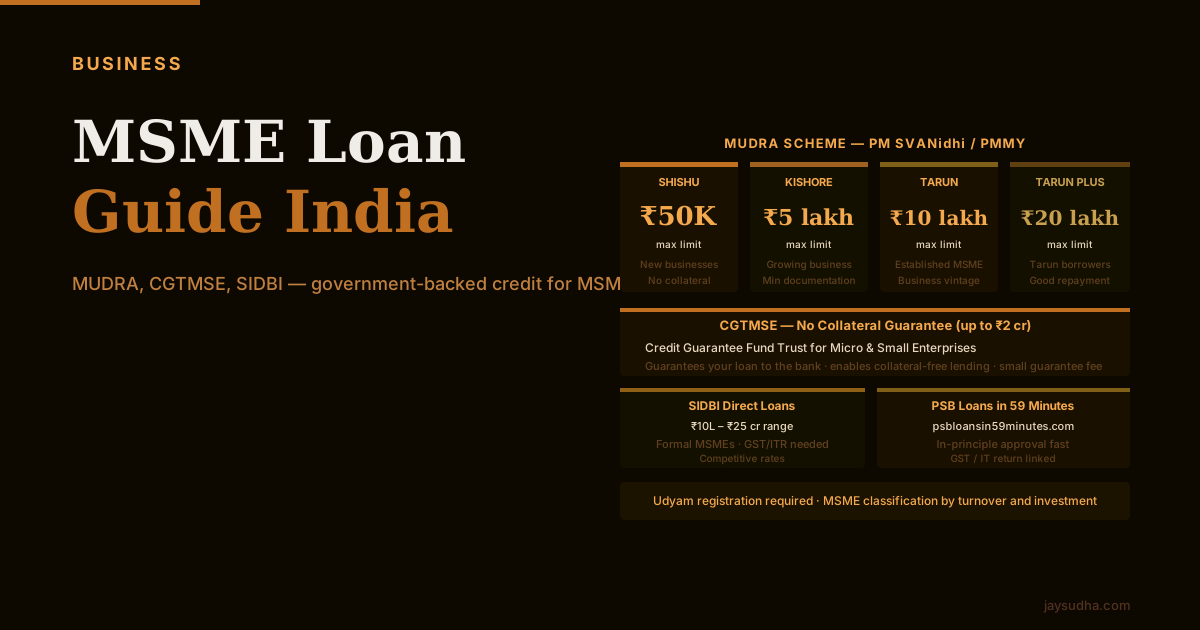
- Shishu: Up to ₹50,000 — for new or small businesses just starting
- Kishore: ₹50,001 to ₹5,00,000 — for established businesses needing expansion capital
- Tarun: ₹5,00,001 to ₹10,00,000 — for larger established micro/small businesses
- Tarun Plus: Up to ₹20,00,000 — for those who've repaid a Tarun loan
Available from: Public sector banks (SBI, PNB, Bank of Baroda), private banks (HDFC, Axis, ICICI), MFIs (microfinance institutions), NBFCs, and small finance banks.
Collateral: None required for MUDRA loans.
Interest rates: Market-based, but generally competitive — typically 10–14% for the larger categories, lower for Shishu.
What MUDRA is not: MUDRA is not a direct lender. It's a refinancing agency. The bank or NBFC gives you the loan; MUDRA refinances the lender. You apply to a bank, not directly to MUDRA.
2. CGTMSE-Backed Collateral-Free Loans
The Credit Guarantee Fund Trust for Micro and Small Enterprises enables member lending institutions to cover eligible micro and small enterprise credit facilities without traditional collateral. The current public CGTMSE material shows fund and non-fund based credit facilities up to ₹10 crore per eligible borrower can be covered, subject to the scheme, lender type and CGTMSE parameters.
How it works:
- Bank gives you a business loan (term loan or working capital) without requiring property or other asset as collateral
- CGTMSE provides the lender a guarantee on the eligible covered portion, with coverage depending on borrower category, amount and scheme rules
- Annual guarantee fee slabs applicable from 1 April 2025 run from 0.37% to 1.20% for the standard slabs shown by CGTMSE; whether the lender passes that cost to you is lender-discretionary
Eligible loan types:
- Term loans for capital expenditure
- Working capital credit (CC or OD limit)
- Non-fund-based facilities (LC, BG)
Maximum cover: Up to ₹10 crore per eligible borrower under the current CGTMSE public parameters, not an automatic entitlement.
Eligibility: New and existing micro and small enterprises with eligible activities and documentation. Banks assess your business on standard credit criteria — turnover, profitability, management quality, cash flow, credit history, repayment capacity and sector risk.
Important limit: "Collateral-free" does not mean "no security of any kind." The lender can still take primary security over assets created from the loan, ask for owner/promoter guarantees where permitted, and reject weak files. RBI's MSME lending directions separately require banks not to accept collateral security for MSE loans up to ₹20 lakh, but that rule does not force a bank to sanction every request.
3. SIDBI Direct Lending
SIDBI (Small Industries Development Bank of India) directly lends to MSMEs through several schemes:
SIDBI Make in India Loan for Small Enterprises (SMILE): Term loans from ₹10 lakh to ₹25 crore for equipment, infrastructure, and capacity expansion.
SIDBI Working Capital Loans: For running capital needs of MSMEs.
SIDBI Energy-Efficient Equipment Financing: Preferential rates for purchasing energy-efficient equipment.
SIDBI's interest rates are often 1–2% below equivalent bank rates, making it a preferred source for medium-sized MSME loans.
How to access: Apply directly to SIDBI online or through partner banks. SIDBI also extends loans through MFIs to reach smaller enterprises.
4. PSB Loans in 59 Minutes
The PSB Loans in 59 Minutes portal (www.psbloansin59minutes.com) supports faster processing of MSME loans up to ₹5 crore from participating lenders. The portal uses GST/sales data, income-tax return details and bank statements to generate an in-principle approval letter when the file passes its checks.
Requirements to use the portal:
- Business GST registration
- 6 months of GST returns filed
- 3 years of ITR (business and owners)
- Bank statements for 6–12 months
- Udyam Registration certificate
After in-principle approval, you still go to the selected bank for documentation, final appraisal and sanction. Treat the 59-minute result as a filtered lead into lender processing, not money in the account.
5. Government Procurement and MSME Credit
If your MSME supplies to government departments or CPSEs (Central Public Sector Enterprises), the TReDS (Trade Receivables Discounting System) allows you to discount invoices and receive early payment:
TReDS platforms (RBI-approved): M1xchange, RXIL, Invoicemart
You upload accepted invoices, financiers bid on them, and the discounting proceeds are paid after the platform, buyer and financier complete their workflow. This can reduce the cash-flow stress of long buyer payment cycles, but it depends on buyer onboarding, invoice acceptance, financier appetite and platform charges.
Delayed payments: For delayed payments by government departments or large companies to MSMEs — the MSMED Act mandates a 45-day (or 15-day default) payment deadline and statutory interest for delay. New complaints are filed on the MSME ODR portal (odr.msme.gov.in), not the older Samadhaan portal. See our MSME delayed-payment guide for the full rule, interest calculator, and filing process.
Which MSME Loan Route Fits Which Need?
| Business need | Better first route | Why | Watch-outs |
|---|---|---|---|
| Tiny working-capital need under ₹50,000 | MUDRA Shishu through a bank/MFI/NBFC | Simpler micro-enterprise category | Higher effective cost can still appear through fees or short tenure |
| Existing micro business needing ₹2-10 lakh | MUDRA Kishore/Tarun or existing banker | Works when records are still simple | Do not borrow a fixed EMI loan for a temporary receivable delay |
| Clean MSE needing larger collateral-free credit | Bank loan with CGTMSE cover | Useful when property collateral is unavailable | Guarantee cover protects the lender, not the borrower from default |
| Seasonal stock or receivable cycle | Cash credit / overdraft / working-capital limit | Interest is paid only on utilisation | Renewal discipline and stock/receivable statements matter |
| Supplying corporates, PSUs or government buyers | TReDS invoice discounting | Converts accepted invoices into cash faster | Buyer onboarding and invoice acceptance are practical constraints |
| New project with subsidy eligibility | PMEGP / JanSamarth route | May combine bank credit and subsidy | Scheme eligibility, margin contribution and bank appraisal still apply |
This decision map is the main practical difference between a useful loan and a dangerous one. A term loan is good for an asset that earns over several years. A cash-credit limit is usually better when the business is profitable but cash is blocked in stock, supplier advances or buyer receivables.
Documents Typically Required for MSME Loans
| Document | Purpose |
|---|---|
| Udyam Registration Certificate | Confirms MSME status |
| PAN (business + promoters) | Identity and tax linkage |
| GST Registration + Returns (12–24 months) | Income proof and turnover verification |
| ITR (3 years) + CA-certified accounts | Profitability verification |
| Bank statements (12–24 months) | Cash flow assessment |
| Projected financials (if seeking a large loan) | Business plan verification |
| KYC of promoters (Aadhaar, PAN, photo) | Identity verification |
| Business registration documents | Proof of entity |
Newer businesses (under 2 years old) find it harder to produce 3 years of ITR — in this case, MUDRA loans and some NBFC schemes are more accessible.
The Application Process in Practice
Step 1: Organise documents Get your last 3 ITRs, GST returns, and bank statements ready in digital format. Ensure they're consistent — the same business PAN, same registration details across all documents.
Step 2: Choose the right lender For small amounts (under ₹10 lakh): SBI, PNB, or a small finance bank with MUDRA For ₹10 lakh to ₹2 crore: PSB portal for speed, or direct approach to a bank where you have a relationship For ₹2–10 crore: SIDBI or established relationship with a PSU bank
Step 3: Approach your existing banker first Your salary or current account bank already knows your cash flows. They're often the most willing lender because they have real data on your transactions.
Step 4: Maintain credit hygiene Business CIBIL (CIBIL Rank) is separate from your personal CIBIL score. Keep your business credit clean: no late repayments, no bounced cheques, no default on existing loans.
Step 5: Work with your CA Your CA typically knows which banks and NBFCs are active in MSME lending in your area and can help structure the loan application to present the business in the best light.
MSME financing is significantly more accessible today than five years ago, partly due to GST-based income verification, the Udyam portal, and digital credit assessment tools. The main barrier is typically not eligibility — it's documentation readiness and knowing which door to knock on.
Improving Your MSME Loan Eligibility
The most common reason an eligible MSME loan application is rejected or receives unfavourable terms is documentation or credit record issues — not scheme availability. What lenders actually look at:
Banking relationship quality: Your business account's average monthly balance, transaction regularity, and absence of bounced cheques or returned instruments matters more than raw turnover. A business with Rs.20 lakh turnover whose account is active, clean, and has a healthy average balance is more creditworthy to the lending bank than a Rs.50 lakh turnover business with irregular account usage and several returned instruments in the past year.
GST return consistency: Banks pull your GST returns data through the GSTN. Gaps in filing, nil returns in months with visible bank credits, or turnover inconsistency between ITR and GST returns are red flags. File on time, every time, even when turnover is low.
CIBIL Rank vs CIBIL Score: Your personal CIBIL score (individual credit score) matters for many MSME loans, especially smaller amounts and when you're providing a personal guarantee. A business-level CIBIL Rank (1-10, with 1 being best) exists separately and tracks your business credit history. Both should be clean. Check both before applying.
Promoter's ITR and income: Especially for proprietorships, your personal ITR is scrutinised alongside business financials. Undeclared income, very low reported income relative to obvious lifestyle, or incomplete ITR filings create problems.
Specific Schemes Worth Knowing
PMEGP (Prime Minister's Employment Generation Programme): A credit-linked subsidy scheme for new MSMEs — up to 25% subsidy on project cost (35% for special categories) for manufacturing projects up to Rs.50 lakh and service projects up to Rs.20 lakh. The beneficiary funds 5-10% of project cost; the bank funds the rest with the subsidy reducing the principal. Applied through KVIC (Khadi and Village Industries Commission), KVIB (state-level), or DIC (District Industries Centre).
Emergency Credit Line Guarantee Scheme (ECLGS): Launched during COVID-19 and modified over time, ECLGS is a status-sensitive scheme. Do not assume it is open for new borrowing just because an old page appears in search. Check JanSamarth and your lender's current scheme page before treating it as an available option.
Standup India: Loans from Rs.10 lakh to Rs.1 crore for SC/ST entrepreneurs and women entrepreneurs setting up new enterprises in manufacturing, services, or trading. Each bank branch must extend at least one loan to an SC/ST borrower and one to a woman borrower under this scheme. If you qualify, this is a significantly underutilised scheme with dedicated targets that improve your access.
Working Capital vs Term Loan: Choosing the Right Product
Many first-time MSME borrowers apply for a term loan when they actually need working capital (or vice versa). The difference:
Term Loan: Fixed amount borrowed for a specific purpose (buy equipment, renovate premises, expand capacity). Repaid over a fixed tenure in EMIs. Interest is charged on the full amount from disbursement. Best for: buying assets, one-time capacity investments.
Working Capital Loan (CC/OD Limit): A credit line you draw down and repay as needed. A Rs.10 lakh CC limit means you can borrow up to Rs.10 lakh, repay Rs.5 lakh, borrow Rs.3 lakh again — interest accrues only on the outstanding amount on any given day. Best for: managing receivables timing gaps, funding inventory cycles, bridging payment delays from clients.
For most service businesses (consultants, agencies, freelancers), a working capital OD (overdraft) limit of 1-2 months of average monthly turnover is far more useful than a term loan. It gives you a cushion for slow months without the fixed EMI obligation of a term loan.
After You Get the Loan
Taking the loan is step one. Managing it well determines whether it helps or hurts the business:
Deploy capital only for its stated purpose: Banks track loan utilisation in the early stages, especially for term loans. Using equipment loan funds for salaries creates compliance problems and erodes your credibility for future borrowing.
Maintain EMI/CC payment discipline from day one: A single bounced EMI or interest default creates a negative mark on your business CIBIL Rank that persists for years. Set up auto-debit for EMI payments and ensure the account always has sufficient balance on repayment dates.
Use the credit line, not just the sanctioned limit: For a CC/OD limit, if you never draw down, the bank may reduce or close the limit at renewal. Moderate, regular usage and prompt repayment builds the credit relationship. This matters for the next application.
Annual renewal/review: Most working capital limits are reviewed annually by the bank. Prepare financials (updated ITR, P&L, balance sheet, GST returns) proactively and approach the renewal 2-3 months before the limit expires. Banks appreciate borrowers who manage the relationship rather than showing up at the last minute.
Common Reasons MSME Loan Applications Get Rejected
Knowing what trips up applications helps you avoid the same pitfalls:
Inconsistency between GST turnover and ITR income: If your GST returns show ₹50 lakh in annual supplies but your ITR reports ₹18 lakh under Section 44ADA (50% presumptive — consolidated into Section 58 under the Income-tax Act, 2025, effective 1 April 2026, with the same 50% rate), this is not fraudulent — but a bank's credit team may flag the gap without understanding presumptive taxation. Have your CA prepare a brief explanation note for any loan file: "Taxable income is 50% of gross receipts per Section 44ADA (presumptive scheme for professionals). Gross receipts as per GST: ₹50 lakh. Taxable income declared: ₹25 lakh."
Personal and business account mixed: A bank reviewer who sees personal expenses (school fees, Amazon purchases, personal insurance premiums) flowing through the business account cannot cleanly assess the business's cash flow. Separate accounts are not just good practice — they are a prerequisite for a clean loan application.
Recent credit enquiries: Multiple loan applications in a short period are visible in your CIBIL report as "hard enquiries" and can reduce your credit score temporarily. Research which lender you want to approach, apply to one at a time, and wait for a decision before applying elsewhere.
Outstanding GST dues or notices: Banks cross-reference your GSTIN with the GST portal. Pending late fees, demand notices, or blocked GSTIN status immediately raises a flag. Clear any pending GST issues before applying.
No formal business address: Many lenders do a physical verification of the business address during processing. A virtual office, coworking space, or home address are all acceptable — but the address on your GST certificate, bank account, and Udyam registration should all be consistent and verifiable.
Negotiating Better Loan Terms as an Established Borrower
Once you have 12–18 months of clean repayment history on a first loan, you are in a meaningfully better position for the next one:
Request a rate review: Banks are not obligated to automatically reduce your rate as your creditworthiness improves. Ask explicitly. "My business has grown, repayments have been on time, and my CIBIL Rank has improved. I'd like to discuss a rate revision." Even a 0.5% reduction on ₹20 lakh over 3 years saves ₹30,000+ in interest.
Negotiate the CC limit at renewal: Working capital overdraft limits are renewed annually. Approach the renewal as a renegotiation, not a rubber stamp. Request an enhanced limit if your business has grown. Bring updated financials (latest ITR, current GST returns, last 6 months' bank statements) proactively — don't wait to be asked.
Use the relationship for other banking products: A good loan relationship opens access to better trade finance products (bank guarantees, letters of credit), forex services for international clients, and occasionally introductions to other bank-sponsored schemes (TReDS onboarding, GeM seller financing).
Putting this into practice
An operating example
A small trader needs ₹10 lakh of working capital before the buying season. The money will sit in stock for 45 days, then in buyer receivables for another 30 days. A five-year term loan creates a fixed EMI even after the seasonal gap closes. A cash-credit or overdraft limit may fit better because interest is charged only on utilisation, and the limit can be reduced when stock converts back into cash.
The same problem appears in agri-trade and rice-mill finance: paddy, transport, processing and customer credit can make the business look profitable on paper while cash is locked in inventory and receivables. In that situation, the key question is not "How much loan can I get?" It is "How many days is cash blocked, and will the loan close that timing gap without creating a permanent EMI burden?"
Use illustrative numbers, not wishful turnover:
| Input | Example |
|---|---|
| Stock purchase and processing cash needed | ₹10,00,000 |
| Stock holding period | 45 days |
| Buyer credit period after sale | 30 days |
| Total cash-blocked cycle | 75 days |
| Sensible facility type to compare first | CC / OD / invoice discounting |
A "10% flat" loan over five years can also look cheap while behaving like a much higher reducing-balance rate. Always compare the reducing-balance rate, processing fee, guarantee fee, insurance, foreclosure rules and renewal charges, not just the EMI.
A common mistake
Comparing a flat rate to a reducing-balance rate as if they're the same, and borrowing a fixed-EMI term loan to plug a working-capital (timing) gap.
When this doesn't apply
If the gap is purely seasonal or a receivables-timing issue, a cash-credit or overdraft limit fits far better than a term loan — you pay interest only on what you use, when you use it.
Jay's operating note: In a seasonal business, the wrong loan type can turn a timing gap into a permanent cost. Match the loan to the cash cycle first, then compare rates.
Your decision checklist
- Flat rate converted to its reducing-balance equivalent
- Loan type matched to the need (term loan for assets, CC/OD for working capital)
- Processing and insurance fees added to the all-in cost
- Collateral-free options (e.g. CGTMSE) checked
- GST and ITR filings clean — they drive eligibility and the rate
- Review the facility against your actual cash-flow cycle
What this article cannot decide
This guide cannot tell you whether your exact application will be sanctioned, what rate a lender will quote, whether a guarantee fee will be passed to you, or whether a state/local document will be accepted by a branch. For large secured borrowing, disputed GST/tax records, weak collateral documents, partnership disputes, or legal notices from lenders, get professional help before signing. The bank's sanction letter and official scheme page override any summary article.
Frequently Asked Questions
Sources and references
- Ministry of MSME — Definition of MSME
- Ministry of MSME — Annual Report 2025-26
- Udyam Registration Portal — Ministry of MSME
- Reserve Bank of India — Master Direction on Lending to MSME Sector, updated February 2026
- MUDRA — PMMY Loan Offerings
- CGTMSE — Credit Facilities and Parameters
- CGTMSE — Annual Guarantee Fee Structure from 1 April 2025
- PSB Loans in 59 Minutes — MSME Loan Portal
- JanSamarth — National Portal for Government Sponsored Schemes
- RBI — Trade Receivables Discounting System FAQ
- GST Portal — GSTR-1 Filing
- Income Tax Department — Section 44ADA Presumptive Taxation FAQ
- TransUnion CIBIL — What Is a CIBIL Score
- Income Tax Department — Income-tax Act, 2025 (FAQs on Interplay and Transition, and Act text)
Rules, rates, and thresholds in India change over time. Always confirm the current position with the official source above before acting on it.