Term Insurance India: How Much Cover You Need and How to Choose
How to size term-insurance cover in India, compare policy conditions, read IRDAI claim data, and understand tax and disclosure limits before buying.
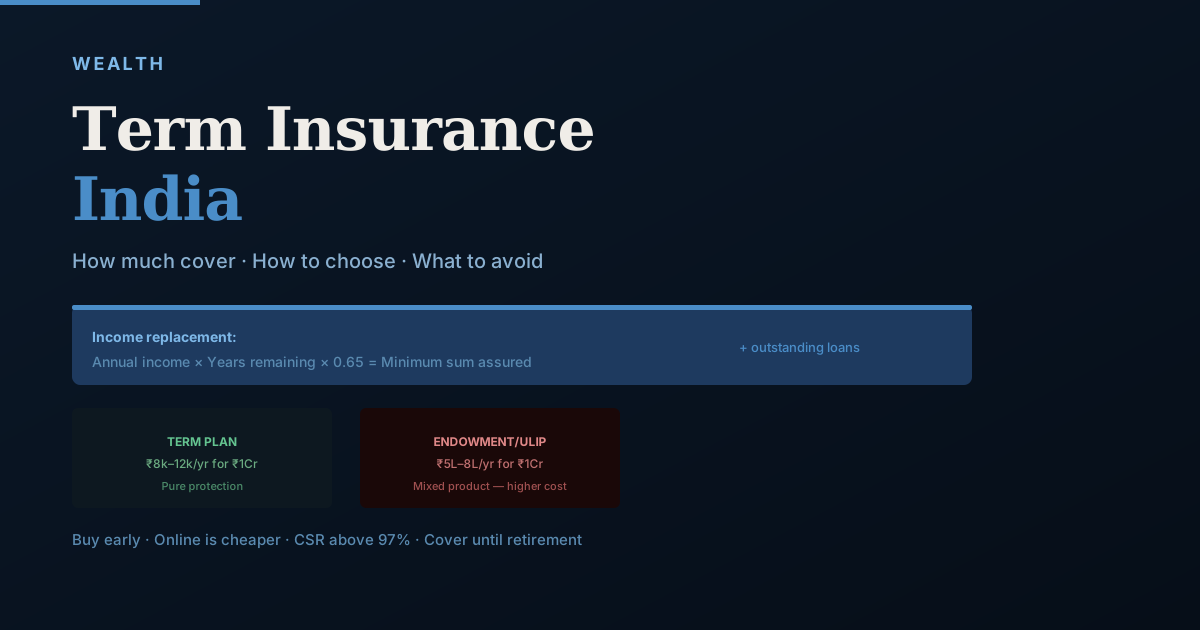
Term insurance is life cover for a specific financial risk: your family loses your income, loan repayment capacity, or business-guarantee support if you die during the policy term. It is not a return product. If nobody depends on your income and you have no meaningful liabilities, the need may be low. If dependents, loans, or personally guaranteed business borrowings exist, the cover amount and term need a real calculation.
The confusion typically comes from conflating life insurance with investment. Endowment plans and ULIPs bundle insurance with investment. Term insurance does not. It provides pure life cover — a large payout if you die during the policy term, nothing at the end if you survive.
For many Indian families with dependents and financial liabilities, a plain term plan is the cleanest starting point. The final decision still depends on income stability, health disclosure, affordability, existing assets, nominee readiness, and the exact policy wording.
Source check: This page was last source-checked on 23 July 2026. The tax references use Income Tax Department AY 2026-27 pages for Section 80C treatment. Insurance-regulation references use IRDAI annual-report, circular/regulation, and Insurance Act materials. Premium ranges below are illustrative only and must be replaced with live quotes from insurers for your own age, health, tobacco status, occupation, cover, and term.
Why term, not endowment
A plain term policy usually gives much higher life cover per rupee of premium than an endowment or investment-linked policy because it is priced for risk cover, not maturity value. That is the main structural advantage.
The trade-off is emotional and practical. A term plan can feel unsatisfying because there is no maturity payout if you survive. Endowment and return-of-premium plans convert that discomfort into a higher premium. Before buying a bundled product, compare:
- Actual life cover your family receives
- Annual premium and payment term
- Surrender value if you stop early
- Charges, guarantees, and market risk
- Whether you can invest the difference separately with lower cost and better liquidity
For a protection need, separating insurance from investment is usually easier to evaluate and easier for a family to understand during a claim.
Calculating how much cover you need
Method 1: Income replacement (recommended)
Sum assured = Annual income × Years of working life remaining × Income replacement factor
For a 32-year-old earning ₹12 lakh per year planning to retire at 60:
- Years remaining: 28
- Income replacement factor: 0.65 (family can manage on 65% of current income)
- Sum assured = ₹12 lakh × 28 × 0.65 = ~₹2.2 crore
Then add outstanding liabilities: if you have a ₹40 lakh home loan, add that to arrive at ₹2.6 crore.
Method 2: 10–15× annual income
A simpler rule: take 10–15 times your annual gross income. At ₹12 lakh, this gives ₹1.2–1.8 crore. This method is less precise but gives a reasonable baseline.
Both methods are starting points, not advice. Higher earners, single-income families, young children, dependent parents, large loans, or personally guaranteed business credit can require more cover. Strong liquid assets, a working spouse with independent income, or already-funded goals can reduce the need.
Term-insurance decision framework
Use this table before comparing plans. It keeps the purchase tied to a real household risk instead of a headline cover amount.
| Question | What to count | Why it matters | Limitation |
|---|---|---|---|
| Who loses income if you die? | Spouse, children, parents, siblings, business partners | Defines whether insurance is needed at all | Dependence can change after marriage, childbirth, retirement, or job loss |
| How long must income be replaced? | Years until children finish education, spouse earns, or retirement corpus is ready | Prevents underbuying a short policy term | Inflation and lifestyle changes can make estimates stale |
| Which liabilities survive you? | Home loan, education loan, personal loan, business loans with personal guarantee | The nominee should not inherit repayment pressure without cash | Check whether loan insurance or collateral already exists |
| What assets are actually available? | Emergency fund, fixed deposits, EPF/PPF/NPS access, mutual funds, existing life cover | Reduces the net cover required | Illiquid assets and family home value may not be usable quickly |
| Can the nominee claim smoothly? | Nominee details, policy document, insurer contact, death certificate workflow | A policy has value only if the family can access it | Nomination is not a substitute for broader succession planning |
Policy term length
The coverage period should last until:
- Your dependents are financially self-sufficient, AND
- Your retirement corpus is adequate to sustain your household
For most salaried individuals, coverage until age 60–65 makes sense. A 30-year-old buying a 30-year term policy is covered until 60.
If you plan to retire early or have dependents with special needs, extend the coverage period accordingly.
Useful riders
A rider is an add-on benefit that can be attached to the base term policy:
Critical illness rider: Pays a lump sum on diagnosis of specified conditions (cancer, heart attack, stroke, etc.). This is separate from the death benefit and can be used for treatment costs and income replacement during illness. Useful — but buy it only if the critical illness benefit is substantial (₹25 lakh or more).
Accidental death benefit rider: Pays an additional amount if death occurs due to accident. Less important for most people — the base sum assured should already be adequate regardless of cause of death.
Waiver of premium rider: If you become permanently disabled, future premiums are waived and the policy continues. This has value for professionals in physically demanding work.
Avoid riders that convert the term policy into an investment product — these erode the simplicity advantage.
How to evaluate insurers
Claim settlement data: IRDAI annual reports publish life-insurer claim data. Use claim settlement ratio as one input, not a single cutoff. Also check claim amounts settled, claims repudiated, pending claims, grievance process, and the insurer's own policy conditions. A high percentage can still hide poor fit if the product wording, exclusions, or disclosure questions are unsuitable for your case.
Solvency ratio: IRDAI-regulated insurers must maintain solvency according to regulatory norms. Treat solvency as a financial-strength signal, but do not use it in isolation.
Financial strength and service: Larger, established insurers may have mature claim and service systems, while newer insurers may compete on digital experience or pricing. Compare the claim-intimation process your nominee would actually use.
Premium vs policy conditions: Compare online for your exact age, gender, tobacco status, term, riders, occupation, income, and health profile. The cheapest policy is not automatically the best if exclusions, revival terms, nominee service, or documentation burden are poor.
Online vs offline purchase
Online term plans are often cheaper because distribution costs can be lower. Buy directly from the insurer or through a properly registered intermediary, and save a copy of the proposal form and policy document.
Offline policies through an agent may have slightly higher premiums but may provide more hand-holding for the claims process in the event of death.
When to buy
The premium is based heavily on age and underwriting at purchase. Buying after a health condition appears can make cover costlier, loaded, excluded, postponed, or unavailable. Do not buy purely because you are young; buy when there is a financial risk to transfer.
How premiums vary with age and cover amount
To make the cost concrete, here is an illustrative structure for a healthy non-smoker male, 20-year term policy, for a ₹1 crore sum assured, purchased online. These are not live quotes and should not be used to choose an insurer:
| Age at Purchase | Approximate Annual Premium |
|---|---|
| 25 | ₹6,500–9,000 |
| 28 | ₹7,500–11,000 |
| 30 | ₹8,500–12,500 |
| 35 | ₹12,000–17,000 |
| 40 | ₹18,000–26,000 |
Premiums can vary materially by insurer, gender, tobacco use, occupation, medical history, family history, payment frequency, rider choice, and underwriting outcome. Non-smokers usually pay less than smokers, but the exact spread changes by insurer and product.
Increasing the sum assured to ₹2 crore may not simply double the premium, but do not assume a fixed discount. Compare the final benefit illustration and premium schedule after underwriting.
Underwriting: what insurers check before issuing your policy
When you apply for a term policy, the insurer assesses your risk profile through underwriting. Understanding this process reduces surprises.
Medical tests: For sum assured above ₹50 lakh to ₹75 lakh (threshold varies by insurer and age), the insurer typically requires medical tests: blood sugar, cholesterol panel, blood pressure, ECG, and sometimes urine analysis. Some insurers do this at their empanelled diagnostic centres at no cost to you.
Income verification: Most insurers require proof of income (salary slips, ITR, Form 16) because the sum assured must bear a reasonable relationship to your income. A person earning ₹8 lakh per year is unlikely to be approved for ₹10 crore cover. The standard multiple is typically 10–25 times annual income depending on age.
Lifestyle disclosures: You must disclose tobacco use (smoking, chewing tobacco), alcohol consumption frequency, pre-existing medical conditions, family history of critical illness, and whether you engage in hazardous activities (adventure sports, certain occupations). Incorrect disclosures are the most common reason claims are rejected — insurers investigate claims thoroughly and non-disclosure of material facts is grounds for rejection.
Occupation risk: Certain occupations are considered higher risk — mining, construction, armed forces roles, aviation (crew), deep-sea diving. These may attract higher premiums or specific exclusions. Disclose your occupation accurately.
What happens if you have a pre-existing condition: Insurers may offer the policy with exclusions (the condition is not covered), charge a higher premium (loading), or decline. High blood pressure and controlled diabetes often result in loading rather than rejection. Cancer, heart disease, or HIV are more likely to result in decline or significant limitation. For pre-existing conditions, compare multiple insurers because underwriting policies differ.
Disclosure and Section 45
Insurance is priced on disclosure. Do not hide tobacco use, alcohol history, income, occupation, travel, past hospitalization, existing policies, family medical history, or a pending diagnosis because an online quote looks cheaper.
Section 45 of the Insurance Act is important for life-insurance disputes. The IRDAI-hosted copy of the Act says a life policy cannot be called into question on any ground after three years from the relevant policy date, and also lays out when fraud, misstatement, or suppression of a material fact can be examined within that period. This does not make false disclosure safe. It means the proposal form should be treated as a legal record, not a sales form to rush through.
The claim process: what your family needs to know
The claim process matters as much as the policy itself. Your family must be able to navigate it without you.
Who is the nominee: The nominee is the person who receives the death benefit. Designate the nominee when buying the policy — typically a spouse, parent, or adult child. A minor cannot directly receive insurance proceeds; if you designate a minor as nominee, the benefit is typically paid to an appointed guardian.
Documents required for a claim:
- Original policy document
- Death certificate (issued by the municipal authority or local body)
- Claimant's statement (form provided by insurer)
- Identity and address proof of nominee
- Bank account details for claim payment
- If death was accidental: FIR and post-mortem report
- If death was due to illness: medical records and treating doctor's certificate
Timeline: Check the current IRDAI master circular and your insurer's policyholder-service document before relying on a timeline. The 2024 policyholder-protection framework materially tightened service turnaround times, and many insurer service documents now show faster death-claim timelines than older 30/90-day summaries. Your nominee should preserve claim-intimation acknowledgement, document-submission proof, and all insurer communication.
Digital claims: Most major insurers now offer online claim intimation. Encourage your nominee to register the claim online, as it creates a timestamped record. Keep a physical folder with the policy document, premium receipts, and a brief note about where to find them.
Important: Inform your nominees where the policy document is stored and how to contact the insurer. More claims go unpaid due to nominees not knowing about the policy than due to claim disputes.
Self-employed and freelancers: specific considerations
Term insurance for self-employed individuals, freelancers, and business owners has some differences from salaried employees.
Income proof: Insurers ask for ITR for the last 2–3 years. If your income is irregular or recently increased, the ITR may not reflect your current earning capacity. File ITR accurately and consistently — it also helps with future loan eligibility.
Calculating sum assured for self-employed: The standard income-replacement formula still applies, but add the business liabilities you have personally guaranteed (loans in the business's name with personal guarantees, working capital credit lines). If your business has partners, clarify whether your term policy needs to cover business loans separately from family income replacement.
Keyman insurance: A separate product — keyman insurance — is designed for businesses where one person (a key employee, partner, or promoter) is critical to operations. The company pays the premium and is the beneficiary. This is a business expense under certain conditions and is different from personal term insurance. If you run a small business, discuss both needs separately with an advisor.
Single life vs joint life term plans
Some insurers offer joint life term plans that cover two individuals (typically spouses) under one policy.
How it works: On the first death, the full sum assured is paid out. The cover for the surviving spouse may either cease or continue at a reduced amount depending on the plan.
When joint plans make sense: When both spouses have income or financial obligations and individual policies would cost significantly more in combined premiums. Some joint plans are priced 10–15% lower than two individual policies for the same aggregate cover.
When individual plans are better: When the spouses' income and liability situations are very different, individual policies with appropriate sum assured for each person are more flexible. Joint plans are also less portable if the couple separates.
For most Indian households, two separate individual policies are cleaner — each sized appropriately for that person's income and liability.
How to compare policies before buying
Rather than comparing a handful of widely advertised plans, focus on these specific parameters when evaluating:
-
Premium for your exact profile: Age, gender, smoker/non-smoker, sum assured, term length. Use at least two insurer websites and one neutral comparison platform.
-
Policy conditions for revival: If you miss a premium, you typically have a grace period (30 days for annual premium mode). If the policy lapses, most insurers allow revival within 2 years with payment of outstanding premiums plus interest. Know this before buying — a lapsed policy during a difficult financial period is a common problem.
-
Sub-standard lives acceptance: Some insurers are more liberal in accepting applicants with health conditions at a loading rather than declining. If you have a condition, apply at multiple insurers simultaneously.
-
Free look period: Check the current IRDAI policyholder-protection rules and the policy document for the applicable free-look period, refund deductions, and cancellation process. Use this period to read the policy schedule, exclusions, riders, nominee details, and proposal-form copy.
-
Premium paying mode: Annual premium typically costs slightly less than quarterly or monthly premium for the same policy (because the insurer earns interest on annual payments). Monthly auto-debit is convenient but pays a small premium for that convenience.
Term insurance and the income tax angle
For AY 2026-27, the Income Tax Department lists life-insurance premium under Section 80C, within the combined ₹1.5 lakh Chapter VI-A limit for eligible old-regime taxpayers. The portal also asks for policy number or document identification details when claiming the deduction.
Do not buy term insurance only for 80C. If your 80C limit is already used by EPF, PPF, tuition fees, home-loan principal, or ELSS, the incremental tax deduction may be zero. New-regime taxpayers generally do not use Section 80C deductions.
The death-benefit tax position depends on the Income Tax Act and policy conditions, including Section 10(10D) rules and exceptions. Confirm the current treatment before relying on it for estate or succession planning. The core reason to buy term insurance remains financial protection for dependents; tax saving is incidental.
What this article cannot decide
This is an educational framework, not personal insurance, tax, legal, or investment advice. It cannot decide:
- Whether your health profile will be accepted by an insurer
- Whether a specific rider is worth the premium for your medical history
- Whether your nominee arrangement is legally enough for succession
- Whether a business loan guarantee should be covered by personal or business insurance
- Whether old-regime tax deductions make sense for your return
Before buying, verify the latest policy wording, proposal-form answers, premium illustration, rider conditions, nominee details, free-look terms, and claim process with the insurer or a qualified professional where needed.
Frequently Asked Questions
Sources and references
- Income Tax Department — Salaried Individuals for AY 2026-27
- Income Tax Department — Individuals with Business or Profession for AY 2026-27
- IRDAI — Annual Reports (Claim Settlement Data)
- IRDAI — Circulars and Master Circulars
- IRDAI — Consolidated and Gazette Notified Regulations
- IRDAI NOC Portal — Insurance Act, 1938 incorporating amendments till 2021
Rules, rates, and thresholds in India change over time. Always confirm the current position with the official source above before acting on it.